When to observe?
The best observing window depends on moonrise, moonset, weather, and your location. Around full moon the disk is above the horizon roughly all night; the live moon phase view shows where the Moon stands right now.
As of publication in July 2026, the next full moon is the Buck Moon on Wednesday, July 29, 2026, at 14:36 UTC, standing in Aquarius. This page lists every full moon and new moon of 2026 and 2027 with exact times in UTC, traditional moon names, and zodiac signs, so you can plan observation nights, photo sessions, and dark-sky evenings well in advance.
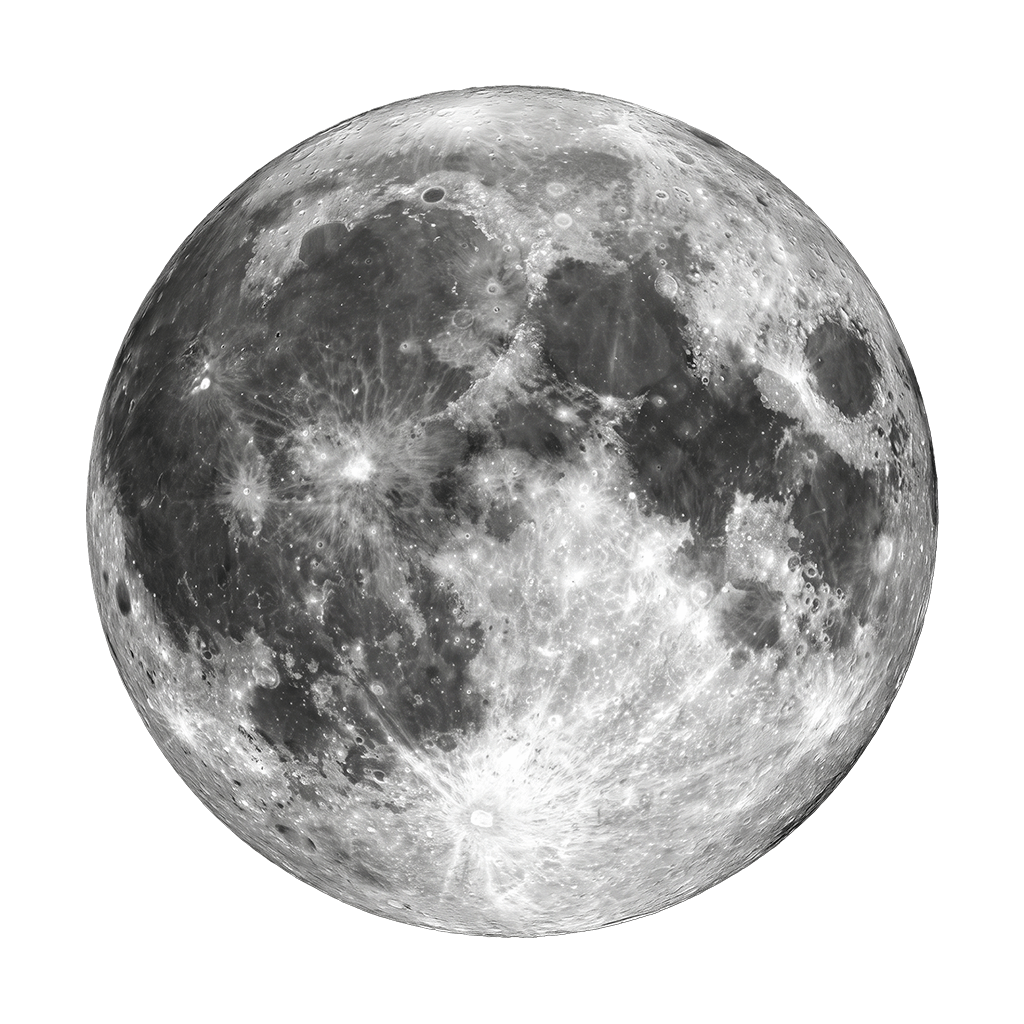
The best observing window depends on moonrise, moonset, weather, and your location. Around full moon the disk is above the horizon roughly all night; the live moon phase view shows where the Moon stands right now.
At full moon the bright lunar maria and ray craters are easy to spot. Fine relief looks flatter, because sunlight hits the visible side almost head-on. For crater detail, the nights just before and after full moon are often more rewarding.
In the lunar calendar you can display full moon, new moon, and quarter phases per month, and the moon phases simulator shows the geometry behind each date.
Every full moon of 2026 with its exact moment in Universal Time (UTC), the traditional moon name, and the zodiac sign it stands in. May 2026 is special: two full moons fall in one calendar month, making the second one a Blue Moon. Convert UTC to your own time zone to get the local moment (Central Europe is UTC+1 in winter and UTC+2 in summer).
| Date & Time (UTC) | Moon Name | Zodiac Sign | Details |
|---|---|---|---|
| Jan 3, 2026, 10:03 UTC | Full Moon 2026 overview | ||
| Feb 1, 2026, 22:09 UTC | Full Moon 2026 overview | ||
| Mar 3, 2026, 11:38 UTC | Full Moon 2026 overview | ||
| Apr 2, 2026, 02:12 UTC | Full Moon 2026 overview | ||
| May 1, 2026, 17:23 UTC | Flower Moon | Scorpio ♏ | Full Moon May 2026 |
| May 31, 2026, 08:45 UTC | Blue Moon | Sagittarius ♐ | Full Moon May 2026 |
| Jun 29, 2026, 23:57 UTC | Strawberry Moon | Capricorn ♑ | Full Moon June 2026 |
| Jul 29, 2026, 14:36 UTC | Buck Moon | Aquarius ♒ | Full Moon July 2026 |
| Aug 28, 2026, 04:18 UTC | Sturgeon Moon | Pisces ♓ | Full Moon August 2026 |
| Sep 26, 2026, 16:49 UTC | Harvest Moon | Aries ♈ | Full Moon September 2026 |
| Oct 26, 2026, 04:12 UTC | Hunter's Moon | Taurus ♉ | Full Moon October 2026 |
| Nov 24, 2026, 14:53 UTC | Beaver Moon (Supermoon) | Gemini ♊ | Full Moon November 2026 |
| Dec 24, 2026, 01:28 UTC | Cold Moon (Supermoon) | Cancer ♋ | Full Moon December 2026 |
The twelve full moons of 2027, again with exact UTC times, moon names, and zodiac signs. The year opens with a supermoon: the Wolf Moon of January 22, 2027 is the closest and largest full moon of the year.
| Date & Time (UTC) | Moon Name | Zodiac Sign | Details |
|---|---|---|---|
| Jan 22, 2027, 12:17 UTC | Wolf Moon (Supermoon) | Leo ♌ | Full Moon January 2027 |
| Feb 20, 2027, 23:24 UTC | Snow Moon | Virgo ♍ | Full Moon February 2027 |
| Mar 22, 2027, 10:44 UTC | Worm Moon | Libra ♎ | Full Moon March 2027 |
| Apr 20, 2027, 22:27 UTC | Pink Moon | Scorpio ♏ | Full Moon April 2027 |
| May 20, 2027, 10:59 UTC | Flower Moon | Scorpio ♏ | Full Moon May 2027 |
| Jun 19, 2027, 00:44 UTC | Strawberry Moon | Sagittarius ♐ | Full Moon June 2027 |
| Jul 18, 2027, 15:45 UTC | Buck Moon | Capricorn ♑ | Full Moon July 2027 |
| Aug 17, 2027, 07:29 UTC | Sturgeon Moon | Aquarius ♒ | Full Moon August 2027 |
| Sep 15, 2027, 23:04 UTC | Harvest Moon | Pisces ♓ | Full Moon September 2027 |
| Oct 15, 2027, 13:47 UTC | Hunter's Moon | Aries ♈ | Full Moon October 2027 |
| Nov 14, 2027, 03:26 UTC | Beaver Moon | Taurus ♉ | Full Moon November 2027 |
| Dec 13, 2027, 16:09 UTC | Cold Moon | Gemini ♊ | Full Moon December 2027 |
New moon nights are the darkest of the month and perfect for stargazing, the Milky Way, and meteor showers. The curated new moon dates below start in May 2026; each linked page covers the zodiac sign and what to observe in that moonless night.
As of publication in July 2026, the next full moon is the Buck Moon on Wednesday, July 29, 2026, at 14:36 UTC. The tables above list every full moon date through the end of 2027, so you can always look up the one following your current date.
A full moon occurs on average every 29.53 days, the length of the synodic month. That gives twelve or thirteen full moons per calendar year. When a second full moon falls in the same calendar month, it is called a Blue Moon, as on May 31, 2026.
The moment of full moon is a single instant worldwide, so this page uses Coordinated Universal Time (UTC) as the neutral reference. To get your local time, add or subtract your time zone offset. Central Europe, for example, is UTC+1 in winter and UTC+2 in summer.
The astronomical full moon is an exact moment in time. To the naked eye, however, the Moon looks essentially full for about one or two nights before and after that moment, when its illumination is already above 97 percent.